
Lark Dunham
Senior Product Manager, GridX
Matt McRitchie
Director of Product Marketing, GridX
First Published Q3 2025

The Origin Story
Back in 2022, a large West Coast utility approached GridX with a compelling problem to be solved. The utility had aggressive goals around decarbonization and electrification and needed their customer’s help to achieve them. However, the process of assessing and purchasing electrification technologies and DER was unnecessarily complex, frustratingly opaque and oftentimes abandoned midstream before any action was taken. The utility needed a solution to this problem and asked, “Could GridX develop an experience that was simple for customers to use and understand, while accounting for all of the complexity inherent to clean energy product adoption?” GridX’s response to this compelling problem statement was an enthusiastic “Yes!”
So, GridX began working with the utility on an extensive discovery process to fully understand the complex market problem and identify effective solutions to meet customer’s needs. GridX needed to better understand the utility’s underlying goals driving the request along with customer perceptions and questions about electrification, DERs, rates and related barriers to adoption. We also conducted market research of the existing available software tools to establish what was available that addressed the defined problem and what gaps existed among available products. The collective findings were quite insightful and informed our development process.
Lessons Learned
Through the extensive market research, GridX identified that most available tools are limited to performing analysis for one DER (e.g. solar, EV, battery storage, heat pump) at a time. Utility customers could understand the impact of an EV with one tool, solar panels with another tool and heat pumps with another, but not all of them together simultaneously as part of a singular experience. This made the assessment process quite manual and inconsistent for people considering DERs. Additionally, many tools asked customers to either estimate or upload energy usage and rate information instead of directly working with customer usage data. Asking the customer to take an additional step of entering or uploading data creates another barrier to usage and risks inaccurate data inputs for impact estimation. The existing product options simply weren’t performing adequately for customers seeking accurate, detailed answers to their complex questions, leading to confusion and limiting engagement.
GridX’s research also discovered utility customers wanted comprehensive lifetime cost information when considering the purchase of large ticket items such as an EV, solar panels, battery storage and heat pump systems. This means understanding not only the upfront purchase price, but also the on-going maintenance costs, any applicable federal, state and local incentives, and energy bill impacts over the life of the purchase. The inputs to understand the total cost of ownership requires significant research from disparate sources, which was another barrier to customers considering the purchase of a DER.

“GridX’s research also discovered utility customers wanted comprehensive lifetime cost information when considering the purchase of large ticket items such as an EV, solar panels, battery storage and heat pump systems. This means understanding not only the upfront purchase price, but also the on-going maintenance costs, any applicable federal, state and local incentives, and energy bill impacts over the life of the purchase.”
GridX Explore Features and Benefits
GridX embarked on building Explore with key customer and market insights in hand. The core functionality for the initial version for residential utility customers includes the following:
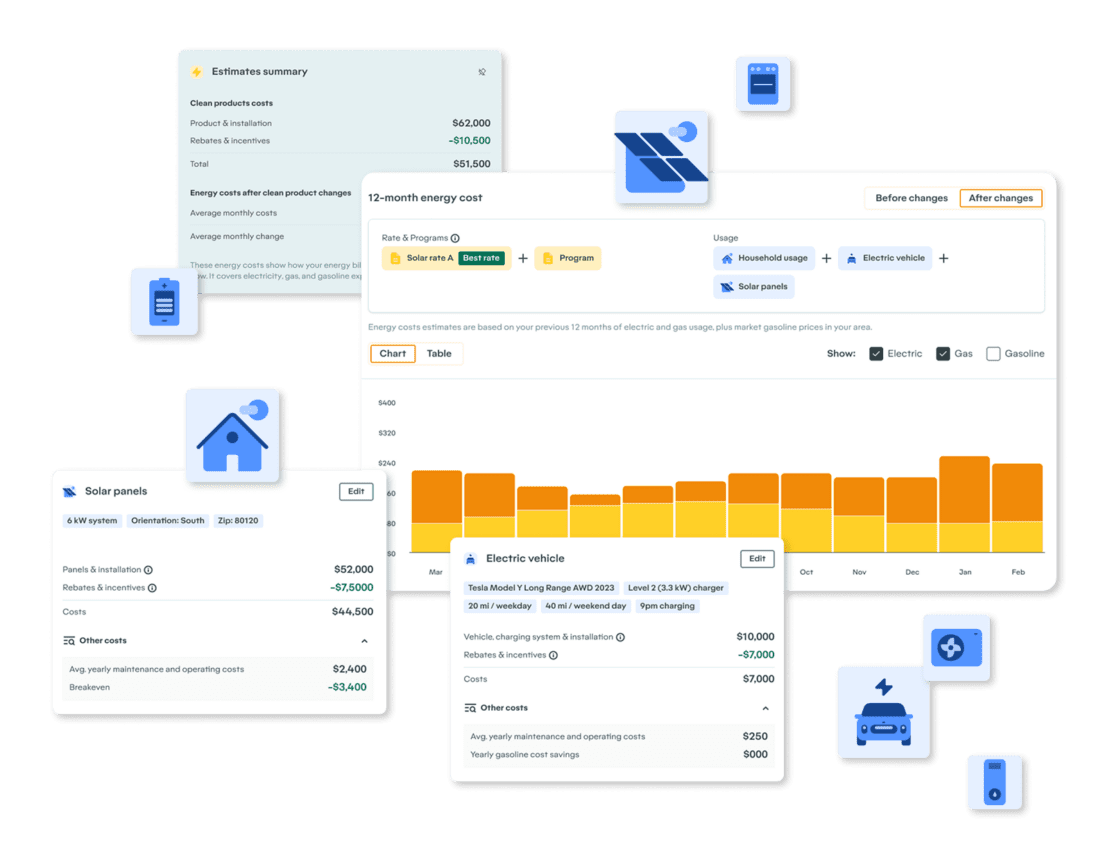
DER Stacking — Customers can model the impact of up to 7 different electrification appliances and DERs including HVAC Heat Pump, Heat Pump Water Heater, Induction/Electric Stove, Heat Pump/Electric Dryer, Solar Panels, Battery Storage, and EVs.
Authenticated Experience via Utility My Account — Utility customers using GridX Explore access it via an authenticated utility web site allowing the application to leverage their actual energy usage and rates.
Total Cost of Ownership — GridX Explore provides the user with all of the inputs to calculate the Total Cost of Ownership for acquiring one or multiple clean energy products. This includes upfront costs, ongoing maintenance costs, eligible rebates & incentives, electric energy cost, natural gas energy costs (if applicable) and rates. If energy savings result, a breakeven calculation is also provided.
Autosizing for Solar and Battery — Residential utility customers may not have the knowledge to manually input sizing for solar panels or battery storage. GridX Explore leverages energy usage and rooftop imaging to automatically size solar and/or battery storage.
Saved Projects — Users can save simulations that will populate the landing page so they can be accessed and refreshed at a later time if additional bills have been issued.
The West Coast utility launched GridX Explore within their My Account page in the summer of 2025. GridX Explore has been set up with a metrics collection system that will enable both GridX and the utility to measure product engagement and ultimately understand if customers purchase the clean energy products they learn more about. This metrics system will ensure the application is indeed helping lower the barriers and accelerate the adoption of clean energy products.
The Future of Explore
GridX has a robust development roadmap for Explore. For residential customers, we plan to provide utility access to the content management system to facilitate direct updates, better support multi-account scenarios and the estimation of the carbon impact for all DER scenarios. While enhancing the residential application, GridX is also developing a non-residential customer version of Explore for Small and Medium businesses, as well as Commercial and Industrial customers.es still rely on legacy Customer Information Systems (CIS) that were designed decades ago. These systems were built to serve accounting and regulatory needs, not to support modern customer-facing communication. They’re inflexible, slow to change, and often incompatible with the kind of design thinking needed to create a better bill.
Layered on top of that is the increasing complexity of rate structures themselves. As the grid evolves, rates are becoming more dynamic, reflecting time, demand, and behavior. That complexity is necessary but it makes creating a clear, digestible bill even more difficult. Utilities are stuck between the need to be transparent and the risk of overwhelming their customers with too much detail.
Get the Digital or Physical Magazine.
